Towards Data Resilience: Why Modern Backup Has Become the Foundation of Digital Transformation
In an era where data has become a company's most valuable asset, losing access to data is no longer just a technical issue—it is a threat to business continuity. Increasingly sophisticated cyber threats such as ransomware demand a far more adaptive approach to data protection than traditional methods. This is why transitioning to Modern Backup is no longer merely an option, but a strategic necessity.
The Evolution of Data Protection: From Traditional to Modern
What is a Traditional Backup Solution?
Before the era of modern backup, data protection strategies relied heavily on tape-based or basic disk-based methods. Their primary focus was solely on data retention for large-scale disaster recovery purposes.
Manual Processes: Often require significant human intervention.
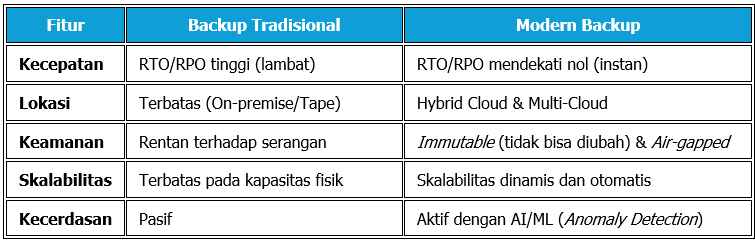
Long Recovery Time: Restoring data from tape or off-site storage can take days (resulting in a high Recovery Time Objective or RTO).
Isolation: Backups are typically passive, remaining unused until a disaster occurs.
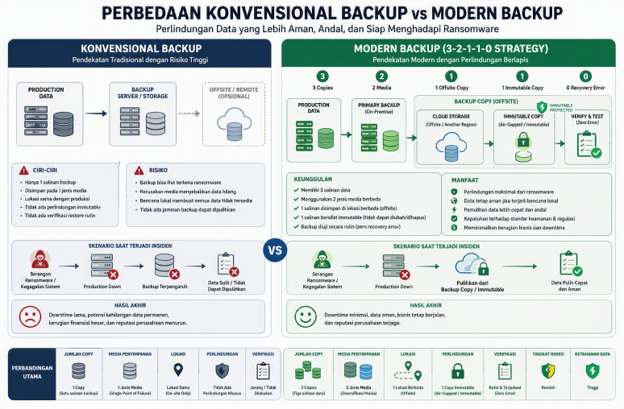
Key Differences: Traditional Backup vs. Modern Backup
What Does Modern Backup Offer?
Modern Backup is not just about storing copies of data, but about ensuring Data Resilience. Key features include:
Immutability: Stored data cannot be deleted or modified by anyone, including ransomware attackers.
AI-Powered Threat Detection: Detects attack patterns or data anomalies in real time before damage spreads.
Instant Recovery: The ability to run workloads directly from the backup system without waiting for a time-consuming restore process.
Data Management: Provides complete visibility into data across multi-cloud and on-premises environments.
Modern Backup Use Cases in Business
Ransomware Mitigation: Organizations can roll back to a point in time before an attack occurred, with the assurance that backup data remains untouched by attackers.
Compliance: Ensures data storage complies with industry regulations (such as GDPR or ISO) through automated audit trails.
Cloud Modernization: Enables seamless data migration across cloud environments (for example, from on-premises to AWS/Azure) without downtime.
MII's Role as a Strategic Implementation Partner
Implementing a Modern Backup solution cannot be done instantly; it requires a deep understanding of your company's IT architecture. MII (Mitra Integrasi Informatika) serves as a highly competent system integrator to support your transformation journey.
How Does MII Help Your Business?
MII has extensive technical expertise in integrating solutions from Cohesity, Veeam, and Commvault into your organization's ecosystem through the following steps:
Assessment & Discovery: MII assesses your current data landscape and identifies security gaps as well as Recovery Time requirements specific to your business.
Customized Design: MII designs the most suitable architecture, whether on-premises, cloud-native, or hybrid.
Expert Implementation: MII's expert team performs installation, configuration, and testing to ensure the system operates according to the highest security standards.
Operational Excellence: After implementation, MII provides ongoing technical support and training to ensure your internal team can operate the Modern Backup system effectively and efficiently.
Interested in learning more about MII's technology solutions and services? Contact our team to discover the right solutions tailored to your business needs.