For years, data backup has been viewed as a "backup copy" that is only used when system failures, data loss, or cyberattacks occur. In the traditional paradigm, backup data is considered a passive asset, stored solely for recovery purposes and rarely utilized for daily business activities. However, as ransomware threats increase, cloud adoption expands, and the demand for faster data analysis grows, the role of backup has undergone significant transformation.
Today, organizations are beginning to transform backup into an active data asset—a data asset that not only functions as a backup but also serves as a source of information for security, compliance, analytics, incident investigation, and Artificial Intelligence (AI) development. This transformation is supported by the Data Security Posture Management (DSPM) approach, which provides visibility, classification, and risk management across all enterprise data, including data stored within backup repositories.
In the conventional model, backup has several primary objectives:
Microsoft explains that modern backup solutions no longer focus solely on storing copies of data but also ensure rapid recovery, security, and business operational continuity. Modern backup is designed to support active data that can be recovered within hours, rather than weeks.
This transformation emerged as organizations realized that backup repositories often contain highly valuable historical data, including:
When properly managed, this data can deliver significantly greater business value beyond simply serving as a recovery mechanism.
Although storage capacity continues to grow, many organizations face several challenges:
The Cloud Security Alliance explains that object storage and backup repositories are often locations where sensitive data is stored without adequate oversight, increasing the risk of data exposure due to misconfigurations or unauthorized access.
DSPM is a security approach focused on protecting data. Unlike traditional security solutions that protect networks or endpoints, DSPM focuses on answering key questions:
Microsoft Purview DSPM provides capabilities to identify unprotected sensitive data assets, detect risky activities, and generate automated security recommendations.
In general, DSPM capabilities include:
These capabilities enable organizations to gain comprehensive visibility into both active data and data stored within backup systems.
The key innovation is transforming backup into an active data repository.
DSPM can classify data stored within backups to identify:
As a result, backup is no longer a "black box" with unknown contents, but becomes a source of security intelligence that can strengthen an organization's security controls.
The NIST Cybersecurity Framework 2.0 emphasizes the importance of continuously creating, protecting, maintaining, and testing backups to ensure cyber resilience. Backup integrity verification also becomes a critical part of the recovery process.
With DSPM support, organizations can:
Backup is transformed from a recovery medium into an active component of a cyber resilience strategy.
Historical data stored in backups can be analyzed for:
Through DSPM, organizations can understand the quality, sensitivity, and risk levels of historical data before utilizing it further.
Traditional Backup to Active Data Backup with DSPM
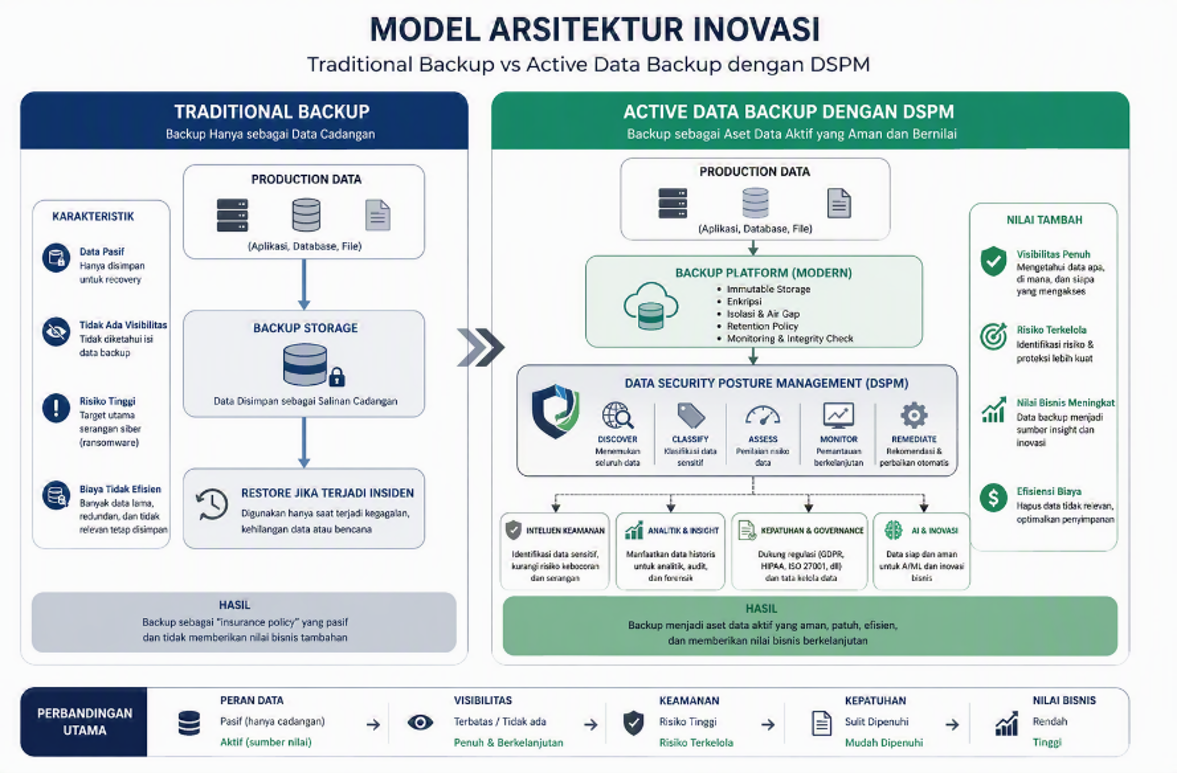
In this model, backup becomes a strategic data source that is continuously monitored and utilized, rather than simply waiting for system failures to occur.
Implementing DSPM within backup environments provides various benefits:
Sensitive data can be discovered and secured faster through classification and continuous monitoring.
DSPM helps organizations map sensitive data and support compliance with regulations such as GDPR, HIPAA, and other data protection policies.
Redundant and outdated data can be identified, reducing storage costs. Cohesity highlights significant storage savings through the identification of unnecessary data.
Validated and actively monitored backups enable faster and more reliable recovery processes during incidents.
Data that has been classified and whose risks are understood can be safely utilized for AI and advanced analytics purposes.
The evolution of data security technology has transformed the backup paradigm from merely a data copy into an active data asset. By integrating Data Security Posture Management (DSPM), organizations gain comprehensive visibility into backup data, identify risks, strengthen compliance, and utilize historical data for security and business needs.
In today's digital era, backup no longer functions only as an "insurance policy" when disruptions occur. Backup has evolved into an active, intelligent, and high-value strategic information source. Organizations that successfully combine cyber resilience, modern backup, and DSPM will gain a competitive advantage in facing cyber threats while maximizing the value of their data.

Digital transformation has evolved beyond implementing a Customer Relatio...

Produktivitas dan efisiensi sangat penting dalam sektor bisnis yang serba...

Tenable One merupakan Exposure Management Platform terpadu yang dirancang...